



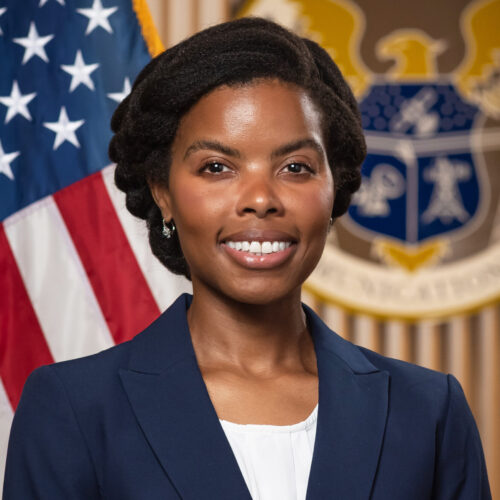
FCC Commissioner Olivia Trusty is defending the agency’s sweeping media ownership reforms, echoing the comments of many broadcasters that outdated regulations prevent stations from competing for ad revenue needed to reinvest in local communities.
In a fireside chat at The Center for Technology Innovation at Brookings with Senior Fellow Nicole Turner-Lee, Trusty commented, “The Commission is working to modernize our broadcast regulatory framework and empower broadcasters to compete for viewers for programming and ad revenues and reinvest those resources into their news gathering operations, hopefully with the ability to expand access to local content and communities across the country.”
Trusty credited Chairman Brendan Carr’s “Delete, Delete, Delete” proceedings with much of the early push. “We’ve been focused on eliminating outdated, unnecessary, and unworkable rules so that we create a regulatory environment that fosters greater investment, innovation, and competition.”
The National Association of Broadcasters, along with many radio groups and owners, has argued in the ongoing 2022 Quadrennial Review that local radio ownership caps are actively harmful in today’s audio and advertising marketplace. NAB’s core position is that radio is being regulated as if it still competes mainly with other radio stations, while in reality it competes with unregulated digital platforms for audience, advertising, and capital.
Trusty’s conversation covered a lot of other, more controversial ground, as well.
“We’ve got a number of proceedings looking at that, whether it’s media ownership rules, whether it’s the next generation standard for television, also referred to as ATSC 3.0. And we’re looking at the relationship between networks and affiliates,” she added, tying that directly into the FCC’s “renewed focus on making sure broadcasters are fulfilling their public interest obligations.”
Trust in media reached 28%, down from 31% a year earlier and 40% five years ago, according to a Gallup report Trusty cited. “The commission does not have a roving mandate to police speech, but we do have a responsibility under the statute to make sure broadcasters are fulfilling their public interest obligations,” she said. “Don’t engage in broadcast hoaxes. We have the equal time opportunity rule. Don’t distort the news. All of that is based on facts in the record, FCC precedent, and the law itself, with the First Amendment as our North Star guidepost.”
As for the FCC’s newly minted directive from President Trump in determining national artificial intelligence policy, Trusty declared, “A patchwork of state AI laws will create a situation of haves and have-nots, where you have some states that might take a more prescriptive regulatory approach to AI stifling investment, where other states might take a light touch approach to AI that might invite more investment in innovation.”
She posited that a national framework provides predictability and certainty for innovators while reducing compliance costs.
Asked about her legacy, Trusty said she hopes the current FCC chapter is “defined by results, that we’ve connected more people, that there have been notable improvements in our infrastructure resiliency and security, and that the decisions that we’re making right now have positioned the United States to lead…when we think about local broadcasting, and beyond.”




Increase competition… That’s a joke… It’s just another nail in the coffin.