




Global media consumption nearly flatlined in 2025, but radio held firm as the number two most-consumed media silo worldwide, trailing only television, with a 2.4% rebound in consumer time spent with all media projected for 2026, per new PQ Media research.
The forecast comes from PQ Media’s Global Consumer Media Usage Forecast 2026-2030, which tracks 11 media platforms and 22 digital channels across the top 20 global markets.
Overall global consumer media usage grew just 0.3% in 2025 to an average of 57.65 hours per week, a sharp deceleration from 2.1% growth in 2024. The slowdown was expected, driven largely by the absence of major international sporting events and fewer federal elections in top global markets. Geopolitical tensions including the Russia-Ukraine conflict, the Israel-Hamas standoff, and global tariff wars partially offset the decline by keeping digital consumption elevated, boosting online video, audio, and podcasting throughout the year.
Digital media’s share of total global consumption rose to 42.6% in 2025, up from 31.4% in 2020. In 11 of the top 20 markets, including the United States, digital now accounts for more than half of all media consumption. Ad-supported media accounted for 52.7% of time spent globally in 2025, down from 55.5% in 2020.
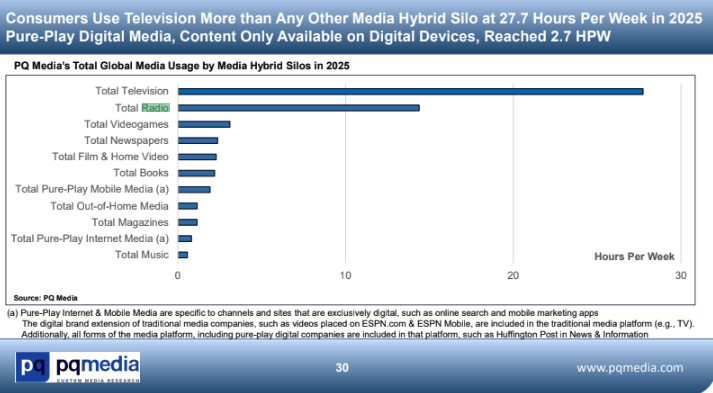
Television remains the most consumed of the 11 platforms PQ Media tracks, reaching 27.74 hours per week in 2025. Radio ranked second among all media silos globally, ahead of videogames, newspapers, film and home video, and books. Mobile video led all 22 digital channels with 13.8% growth, while OTT video was the most consumed digital channel at 9.50 hours per week.
On AI, PQ Media found it is currently having only a minor impact on consumption, with AI-powered search queries actually shortening the time some users spend online rather than extending it.
PQ Media CEO and Founder Patrick Quinn said, “We saw no indication that the uncertain worldwide economy caused by the various geopolitical tensions and shifting economic policies in 2025 negatively impacted media usage. Instead, consumers reverted to previous media consumption habits we’ve tracked over the past 25 years, in that they use media as a catharsis when the economy weakens and more people are stuck at home after losing a job, allowing them to watch more television and read more books, among other secular media consumption habits.”