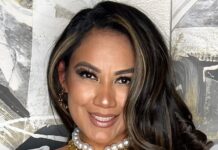

FCC Commissioner Anna Gomez took another opportunity to highlight what she calls an administration bent on “censorship and control” on Monday, but the lone Democrat Commissioner was selective with her other comments at NAB Show 2026.
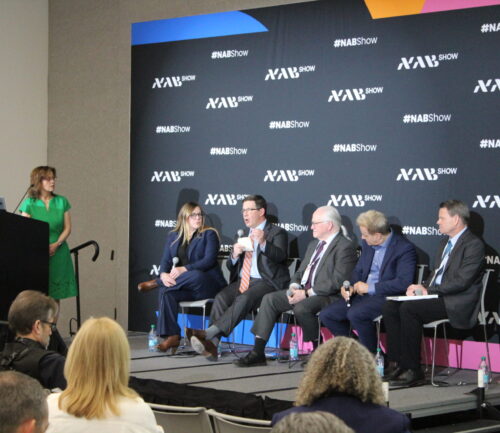
Gomez moderated a full session in which First Amendment attorneys and press freedom advocates argued that FCC Chairman Brendan Carr’s ongoing threats against broadcast licensees are legally untenable, constitute informal censorship, and may already be generating the evidentiary record needed to challenge them in court.
Reporters Committee for Freedom of the Press Senior Staff Attorney Mara Gassmann opened by addressing what she called a widespread misconception about broadcast regulation. “Viewpoint discrimination, basing actions based on the content of news reporting or speech, is poison to a free society,” she said, citing a comment from Supreme Court Justice Samuel Alito. Her organization, she noted, has been tracking incursions on press freedom across multiple federal agencies under the current administration.
Foundation for Individual Rights and Expression Chief Counsel Robert Corn-Revere, who spent four decades as a First Amendment litigator and served as legal counsel to a former FCC chairman, framed Carr’s invocations of the news distortion rule and broadcast hoax rule as legally hollow. “These really aren’t rules,” he said, describing news distortion as a vestigial corollary of the Fairness Doctrine that survived only as a phantom limb after the doctrine’s repeal under Republican chairmen Mark Fowler and Dennis Patrick in the 1980s.
He argued that successive Supreme Court decisions have continuously constrained FCC authority over programming content and that Carr’s public statements about revoking licenses over news coverage are “completely contrary” to settled law.
Stand Together Vice President of Legal Strategy Casey Mattox pointed to Moody v. NetChoice and NRA v. Vullo as the most directly applicable recent precedents. Both, he said, reinforce that the government cannot use regulatory leverage to coerce private speakers into changing their content. “If you allow the accumulation of large amount of government power and a lot of discretion and how that government power is exercised by the executive branch, you’re going to have a lot of First Amendment problems,” Mattox said. He also encouraged broadcasters to think beyond their own immediate interests, arguing that protecting anonymous speech, associational rights, and the First Amendment rights of corporations broadly would ultimately serve the industry’s own legal standing.
American Enterprise Institute Nonresident Senior Fellow Clay Calvert focused on the Moody majority opinion authored by Justice Elena Kagan, reading aloud the court’s declaration that “it is not the job for the government to decide what counts as the right balance of private expression” and that “the state has no right to interfere with private actors’ speech to advance its own vision of ideological balance.” He connected that standard directly to Carr’s stated rationale for pursuing bias-based proceedings, calling it a textbook example of the conduct Moody forbids.
Wall Street Journal Staff Reporter Joe Flint offered the panel’s most practical framing of the evidentiary challenge. Broadcasters and reporters who want to build a jawboning case, he said, face the same problem as any journalist working a story: witnessing effects without having seen the cause. “I wake up in the morning, there’s snow on the ground. I know it’s snow, but did I prove it? I was asleep. I missed the snowfall,” Flint said.
Courts reviewing actions against NPR, PBS, and Voice of America have already treated the administration’s public statements as circumstantial evidence of viewpoint-based targeting, he noted, pointing to decisions by Judges Moss and Lamberth, the latter a Republican appointee, as signals that informal pressure campaigns are increasingly legible to the judiciary. “These people are shouting it from the rooftops,” he said. “They’re all over social media describing exactly what they want to do and how they’re going to do it.”
The panel’s final exchange took up whether scarcity, the foundational legal justification for differential FCC content regulation since Red Lion Broadcasting Co. v. FCC in 1969, still holds. Calvert called it indefensible in a media environment defined by streaming, satellite, and on-demand content. Corn-Revere went further, arguing the scarcity rationale never made sense as a constitutional matter and that the entire framework for broadcast-specific content regulation rests on a premise the courts have steadily eroded since Red Lion itself.