

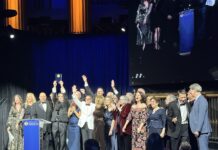

The Harvard Club of New York City played host to an electric day of rugged optimism, as top executives from radio and television gathered for Forecast 2026 on Wednesday to discuss how not only is broadcast media still standing, but it has the cards it needs to win.
Radio Ink President and Publisher Deborah Parenti set the tone for the sold-out room with her opening remarks, drawing attention to broadcast’s battle with unregulated Big Tech rivals and challenging those in attendance to preserve the industry’s core strengths: authentic voices and trusted community connection.
Event MC Juliet Huddy welcomed Cox Media Group President of Radio Rob Babin and Nexstar Networks President Sean Compton, conference co-chairs, to expand on the year’s themes. Babin and Compton framed the platforms not as legacy, but as foundational and critical to American democracy.

The first session, moderated by Miller Kaplan Partner Andrew Rosen, brought together Beasley Media Group Chief Revenue Officer Tina Murley, Futuri founder and CEO Daniel Anstandig, and WPP Media North America Executive Director Jen Soch. The panel addressed the industry’s data and measurement challenges, but with solutions, not complaints. Amazon’s partnerships with Roku and SiriusXM were discussed not as threats, but as validation of broadcast’s scalable “one-to-many” model.
Randy Michaels took the stage next to lead a spirited discussion on broadcast as an investment class, joined by Kalil & Co. Managing Director Todd Hartman, Circle City Broadcasting CEO DuJuan McCoy, RBC Capital Markets Managing Director Marcos Torres, and Connoisseur Media CEO Jeff Warshaw.

Making their predictions as deregulation advances, the conversation turned to a candid, raw discussion about broadcast debt that led to some squirms in the audience, but turned to how these experts navigate the realities many companies face today, together.
Quu CEO Steve Newberry was next up, leading a panel with Norsan Media’s Natalia Sanchez Alvarez, The Oasis and WAKY’s Jeff Ziesmann, and Lilly Broadcasting’s Brian Lilly. Their focus: localism as a competitive advantage. Local isn’t a limitation, they agreed, it’s the differentiator Big Tech can’t duplicate. While global platforms chase scale, local broadcasters still command community trust.
MediaRadar’s Brett House moderated Broadcast’s Digital Reckoning with Hearst’s Jessica Hogue and Credera’s Rio Longacre. The session reframed “reckoning” as reinvention. The panelists discussed turning broadcast into precision growth engines, not abandoning reach, but refining it with data.

Over lunch, Randy Michaels and former TEGNA EVP and COO Lynn Beall were honored for leadership. Then the crowd was graced with the wisdom and experience of legendary First Amendment attorney Floyd Abrams. From recent threats to the precedents set by New York Times v. Sullivan to the rights and importance of a free press, Abrams reminded the room of the fragility of our cornerstone of democracy and our duty to protect it.
Even with the early start, there was no post-lunch lull as the room remained particularly full in the afternoon sessions.
Radio Ink Editor-in-Chief Cameron Coats stepped in for the Kentucky Broadcasters Association’s Chris Winkle, moderating a regulatory update with Cox Media Group’s Alysia Long, broadcast attorney Frank Montero, and Telecommunications Law Professionals’ Gregg Skall. The “Carr Talk” went into extensive detail about the 2022 Quadrennial Review, “Delete, Delete, Delete,” and the battle to keep AM radio in the automobile – the latter of which received some very promising news, mid-panel.
This year’s very active audience was fully engaged in a question-and-answer session centered around content with MediaCo’s Brian Fisher and Audacy’s Jeff Sottolano, led by national TV anchor Gigi Stone Woods. Both Sottolano and Fisher highlighted a plethora of real-world, hybrid models that layer new revenue streams atop traditional platforms.
But it was the late afternoon session that turned the room electric. Straight Shooter Media CEO and multimedia personality Stephen A. Smith sat down with McVay Media President and newly-minted Radio Hall of Famer Mike McVay to talk about his unconfined approach to the business of broadcasting in an unforgettable round of hard truths, hot takes, and unbridled optimism – including what drew him to SiriusXM over AM/FM in his recent triumphant return to radio.

The event closed with the annual Executive Super Session featuring Babin, Compton, and NAB President and CEO Curtis LeGeyt, moderated by ABC News National Correspondent Steven Portnoy. The discussion brought the day full circle: broadcast’s future isn’t theoretical. It’s being built right now by people who’ve weathered every disruption and still deliver for audiences daily.
What emerged at Forecast 2026 was one part revolution, one part clarity united by the conviction that local connection, free expression, and trusted storytelling aren’t relics. They’re the foundation of what comes next.
By the time the last applause faded, many in the room were already marking their calendars for November 12, 2026, when Forecast returns to the Harvard Club. Because if this year proved anything, it’s that the future of broadcast doesn’t belong to those predicting its end. It belongs to those still in the room, who keep building it.


While I could not be there to hear this excellent lineup of speakers, I agree and have preached in my college classroom in the past, localism is radio’s future as is creative use of the word “you” that was taught in the distant pass by Arthur Godfrey and so many other successful radio broadcasters. When the “problem” of debt service is solved broadcasters will hopefully invest in their individual stations instead of using them as the source of cutbacks. Did any panel speakers give specifics of “how to”? Do college-university instructional programs even mention radio today? – – Russell Jackson, Palomar College San Marcos, CA, retired.
Comments are closed.