


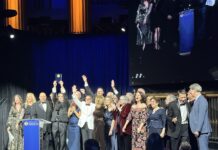

“For years, the FCC has treated TV and radio broadcasting as though it exists in isolation,” said NAB President Curtis LeGeyt during an impassioned address urging the FCC to modernize its longstanding broadcast ownership rules.
Speaking to The Media Institute’s 2025 Communications Forum, LeGeyt emphasized that outdated regulations are restricting local radio and television stations’ ability to compete against digital and streaming giants, threatening the future of free and local news.
LeGeyt underscored the vital role broadcasters play in democracy, providing critical journalism, emergency information, and community-focused programming. However, he warned that the current regulatory framework – unchanged for decades – has failed to account for the rise of tech platforms such as Spotify, YouTube, TikTok, and other streaming services at play in the media landscape.
“Local broadcasting is a highly regulated business in a rapidly evolving sector of the economy. Rapid evolution and government regulation are words that historically do not go together. As broadcasters, we have lived through that disconnect,” LeGeyt said.
“For years, the FCC has treated TV and radio broadcasting as though it exists in isolation, ignoring the rise of cable, satellite, streaming, and social media platforms that dominate today’s media consumption. These new competitors are not bound by the same public interest obligations as local stations, nor do they face the same regulatory burdens.”
LeGeyt pointed out that platforms like Netflix, YouTube, and Spotify can reach all American households without restrictions, while broadcasters remain subject to FCC-imposed caps.
He argued that restrictions on station ownership not only limit competition but also impact the ability of broadcasters to invest in journalism and local news. As newspapers continue to shut down, local TV and radio stations have stepped in to fill the gap, but he warned that restrictive ownership rules threaten their sustainability.
“These national and local ownership rules were crafted to promote competition, but in practice, they give Big Tech a free pass to dominate and serve audiences with content based on algorithms that reinforce our biases and divide us rather than bring us together,” LeGeyt said. “In contrast, local stations deliver content that is meant to serve our collective community. Yet, we are competing with both arms tied behind our backs. The consequences of this are alarming.”
“Without a necessary course correction in our ability to compete for local advertising, local newsrooms will continue to downsize, robbing the community of its voice,” LeGeyt said. “Eliminating these regulations will allow local stations to aggregate resources, invest in journalism, and strengthen their service to communities.”
LeGeyt stressed the critical role of local broadcasters during emergencies, providing real-time information to keep communities safe. He pointed to recent wildfires in Southern California as an example of broadcasters’ indispensable role. “As fire spread rapidly through neighborhoods, local stations in the area provided wall-to-wall coverage, with viewership and listenership doubling and even tripling as people turned to the trusted voices they rely on during crises,” LeGeyt said.
He warned that if broadcasters are not given the ability to scale up and compete, their ability to provide these essential services will be jeopardized.
As such, LeGeyt called on the FCC to take immediate steps to reform ownership regulations. “The FCC must – and can – act quickly to address this imbalance. But we don’t have time to slow-roll these changes,” he stated.
Among the policy changes LeGeyt proposed were modernizing local radio and TV ownership rules to reflect the current competitive landscape and allowing broadcasters to expand station ownership to provide better services and compete for advertising dollars against tech giants.
“We are doing our part to serve our communities at the very time they need us most,” LeGeyt said. “And we look forward to working with the FCC and Congress to do their part to ensure local broadcasters can be unshackled from the outdated rules that have held us back for so long. The time to act is now.”
This article is contradicting. It reads like a push to allow even MORE corporate ownership. Or are they talking about allowing more power? They need to cap the ownership back down. Free up stations for more individualized ownerships. 9/10s of radio’s failure is corporate and feeding them with the same birds. Never seen such Government incompetence.
LeGeyt says, “The FCC must – and can – act quickly to address this imbalance.
Did he detail the “imbalance?”
“LeGeyt proposed …modernizing local radio and TV ownership rules to reflect the current competitive landscape and allowing broadcasters to expand station ownership to provide better services and compete for advertising dollars against tech giants.”
Expand in which ways? Is this a push that has opened the door for people like Soros to have a bigger piece of radio? That move is NOT good for radio or broadcasting.
Comments are closed.