


When CRS 2023 convened a last-minute “emergency” panel on generative AI in radio, the mood of the packed room was bleak. Jump to CRS 2025. AI is no longer considered an existential threat and, if anything, broadcasters are now curious more than anything.
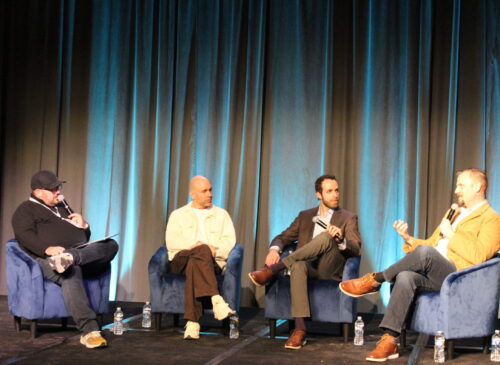
As a tool that’s actively reshaping operations, content creation, and audience engagement, an Are You AI Curious? panel, moderated by Super Hi-Fi Director of Radio Programming Services Bo Matthews, featured insights from Alpha Media’s Phil Becker, Audacy’s Clay Walker, and Radio.Cloud’s Andrew Scaglione, each offering a practical perspective on AI’s impact on the industry and the importance of experimentation.
For Becker, AI is no longer an optional innovation but a necessity for scaling operations. Operating under a “seven-transmitter model” – on-air, streaming, and five social media platforms – he personally relies on AI to manage daily tasks, from answering emails to assisting in video production.
He also provided an update on the initally-controversial AI Ashley project, stressing that AI has not been the talent replacement tool it was first thought to be. “AI Ashley covers about 30% of [Ashley Elzinga’s] breaks, yet she’s paid the same while doing less work. It hasn’t been the fear-based thing people thought it would be,” he explained. Becker noted that listener response has remained neutral – there’s been no impact on ratings.
Walker emphasized that AI is helping Audacy stations move beyond automation and focus more on local engagement. “No matter how you try to contain it, radio personalities are going to find a way to use it to their unique advantage.” The conversation also touched on how many companies that once forbade AI usage are now integrating it into daily workflows. However, Walker acknowledged AI’s pitfalls, particularly the potential for misinformation, reinforcing the need for human oversight. “You have to have a human in the loop to prevent [AI] hallucinations.”
Scaglione pointed to AI’s ability to improve efficiency across multiple departments. “Day to day, it helps us do more with less,” he said. He discussed his lasting curiosity from a keynote delivered by futurist Matt Britton at Radio Ink‘s Forecast 2025 last November. Britton trained an AI model with his medical history to create a personal WebMD. Applying that concept to radio, Scaglione suggested that stations could train AI models on years of streaming, sales, and technical data, creating a custom GPT that serves as a knowledge base for the station or market.
Becker sees AI’s biggest opportunity in sales, where it can enhance proposals, spec spots, and personality profiles for clients from LinkedIn and other online presence data.
As AI tools become more integrated into radio operations, the ability to write effective prompts is now a valuable skill. “The more specific prompts you can create, the better the outcome,” Scaglione advised. Walker echoed the sentiment, adding that being able to write good prompts is now an important skill set to get hired.
The panelists highlighted three key AI tools: CapCut Desktop for video editing, PodcastAI for generating social media content from audio/video, and ChatGPT for general AI assistance.
The panel’s core message was clear: AI is already here, there’s no need for fear, and it’s time for broadcasters to start incorporating it into their work.