



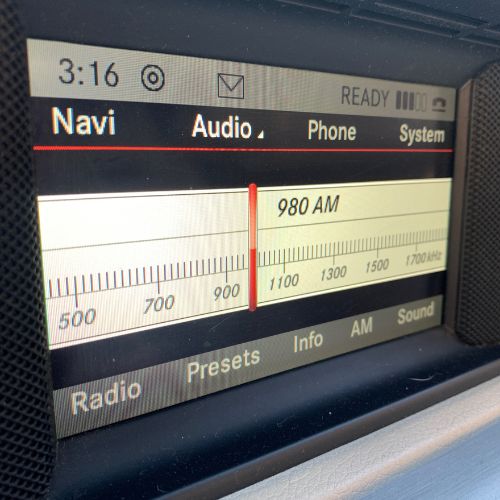
The Congressional Budget Office has released its latest cost estimate for the US House version of the AM Radio for Every Vehicle Act, finding once again that mandating AM radio access in new passenger vehicles would impose only minimal costs on automakers.
The estimate for H.R. 979, dated March 16 and based on the version reported by the House Committee on Energy and Commerce last November, projects that implementing the rule would cost the Department of Transportation and the Government Accountability Office a combined $1 million over the 2026–2031 period. The CBO also expects that civil penalties assessed against noncompliant manufacturers would generate less than $500,000 in revenues over the following decade, given that violations are expected to be rare.
It marks the third time the CBO has weighed in on legislation of this kind, with matching estimates issued in 2024 and 2025. The figures have remained consistent throughout.
The bill would direct DOT to issue a rule requiring AM broadcast reception in all passenger motor vehicles manufactured, imported, or sold in the United States. DOT would have one year from enactment to finalize the rule, which would automatically sunset eight years later. The agency would also be required to report to Congress on the rule’s effects every five years.
Separately, the GAO would be tasked with studying AM radio’s role in the Integrated Public Alert and Warning System within one year of enactment.
The CBO estimates that the private-sector mandate would primarily affect electric vehicle makers, many of whom have already removed or announced plans to remove AM receivers from their lineups. Based on current EV sales data, the agency projects the rule would require updates to roughly 2 to 2.5 million vehicles per year. Since most EVs already include FM radio hardware, the incremental cost would likely amount to software updates and minor hardware modifications; a total burden CBO puts at “several millions of dollars” annually, well below the $214 million annual threshold for private-sector mandates under the Unfunded Mandates Reform Act.
The bill would also preempt state and local laws governing AM radio access in passenger vehicles. CBO estimates that preemption would have no meaningful fiscal impact on state or local governments and would fall far below UMRA’s $107 million intergovernmental threshold.
The estimate arrives as the broader AM Radio for Every Vehicle Act has built considerable momentum on Capitol Hill. The legislation now claims more than 375 co-sponsors across both chambers, and President Trump recently reaffirmed his support for the bill during a nationally syndicated radio appearance. Nearly one million AM listeners have contacted their lawmakers in support of the measure, according to the National Association of Broadcasters, which has launched a new round of state-specific “Depend on AM” PSAs thanking legislators by name.
The bill is currently awaiting a floor vote from House and Senate leadership.