



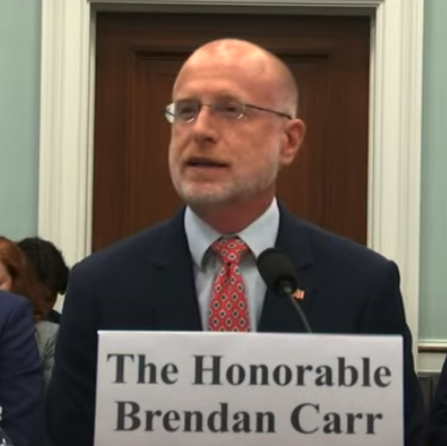
Tensions flared during a House Appropriations Subcommittee hearing this week as lawmakers grilled FCC Chairman Brendan Carr over his agency’s recent deregulatory moves, budget decisions, and actions against Diversity, Equity, and Inclusion practitioners.
The Wednesday hearing, part of Congress’s broader oversight responsibilities of the FCC’s budget and activities, highlighted the stark political divide over the Commission’s direction under Carr’s leadership. While Republicans on the Subcommittee praised cost-cutting and deregulation initiatives, Democrats voiced concerns over what they perceive as partisan actions aligned with the Trump Administration.
Subcommittee Chairman and Ohio Republican Dave Joyce opened by commending Carr for reducing spending and regulatory burdens. Joyce pointed to a $567 million reduction in contract ceiling value and noted that the FCC’s budget remains flat at $390.2 million for FY 2023, fully offset by regulatory fee collections. He emphasized the Commission’s transfer of surplus funds to the Treasury as evidence of fiscal prudence.
Carr’s appearance came amid ongoing criticism from Democrats, led by Subcommittee Ranking Member Steny Hoyer (D-MD). Hoyer accused the FCC of drifting from its role as an impartial communications regulator and becoming a political tool in broader culture war battles. He cited actions targeting media organizations like NPR and PBS and challenged the Commission’s inquiry into private-sector DEI initiatives.
Hoyer said those moves reflect a troubling trend: “What was once an independent, impartial agency… has become, in my view, to some degree ‘the speech police,’ another cudgel in the President’s culture war.”
Representative Sanford Bishop (D-GA) raised additional concerns over whether FCC actions on corporate DEI programs were diverting resources from core responsibilities like rural broadband expansion and spectrum management. When asked to quantify the time and resources spent on DEI investigations, Carr responded that he would follow up but assured the committee that no trade-offs had occurred.
Carr defended the FCC’s recent actions, including the “Delete, Delete, Delete” deregulatory initiative, aimed at eliminating outdated or unlawful rules. He also updated lawmakers on agency staffing reductions – from 1,461 employees at the start of FY 2025 to 1,383 by April 28 – and a savings of $6.7 million for the remainder of the fiscal year due to trimmed contract expenses.
Carr concluded his remarks by urging Congress to restore the FCC’s authority to auction spectrum and affirmed his intention to continue modernizing and streamlining the agency.