




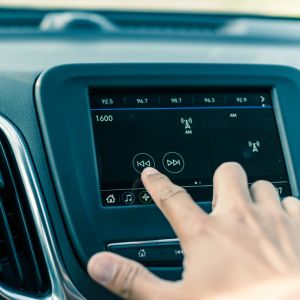
Nearly three years after its introduction, the AM Radio for Every Vehicle Act appears closer than ever to becoming law as 2025 closes. So what will it take to get the bill across the finish line? The NAB is giving an update on the path forward for this landmark legislation.
On the latest NAB Podcast, NAB SVP of Communications Alex Siciliano spoke with NAB Senior Vice President of Government Relations Nicole Gustafson about the bill’s remarkable journey from a niche concern to a bipartisan triumph, the obstacles that have delayed final passage, and why continued broadcaster advocacy remains essential.
“This issue has really been a master class in legislating and lobbying,” Gustafson reflected. “I’ve been in DC for over two decades, and I’ve never seen something go from a non-issue to commanding such overwhelming support in such a short time.”
The legislation, informally known as “AM Forever” in Washington, would require automakers to include AM radio as a standard safety feature in all vehicles sold in the United States. The push began after several manufacturers announced plans to remove AM receivers from new electric vehicles, citing interference concerns. Those announcements, Gustafson noted, “triggered a national backlash that no one expected.”
“The reaction was so swift and forceful that Ford reversed course,” she recalled. “But when other automakers pressed ahead, we knew legislative action was necessary.”
Introduced early in the 118th Congress, the measure quickly attracted an unusually diverse coalition. Gustafson described the political breadth as “almost unheard of in today’s DC.” In the House, 316 of 435 members co-sponsored the bill, while 61 senators from both sides of the aisle signed on. “Ted Cruz and Ed Markey are leading the charge,” she said. “They couldn’t be more different politically, but they united around this issue because it matters to their constituents.”
The coalition extended far beyond Capitol Hill, drawing backing from AARP, the Heritage Foundation, labor unions, churches, emergency management agencies, first responders, and state officials. “We’ve got governors, attorneys general, diversity organizations, and local broadcasters all lined up,” Gustafson said. “The roster is extensive.”
This groundswell of support emerged from deliberate grassroots outreach by stations nationwide. “Many of our members aired PSAs, featured stories in newscasts, and urged listeners to contact their representatives,” she explained. “That constituent pressure generated real momentum on the Hill.”
Yet despite broad support, procedural hurdles have repeatedly stalled progress. Gustafson pointed to shifts in how Congress operates. “Smaller bills used to move throughout the year before getting rolled into year-end omnibus packages,” she said. “That doesn’t happen anymore. Members reject thousand-page bills they haven’t read, which means worthy legislation like ours gets discarded in the process.”
The NAB and its allies had to restart efforts in the new Congress, reintroducing the bill and rebuilding support. Both chambers advanced the measure through committee this fall with resounding approval. The Senate Commerce Committee reported it out with just one dissenting vote, while the House Energy and Commerce Committee passed it 50–1. “The lone ‘no’ vote even said he didn’t want to make a fuss about it,” Gustafson noted. “He simply objected to the mandate itself.”
Then timing struck again. The September 30 government shutdown stalled House business for over a month, creating a legislative logjam. Despite this setback, leaders including Speaker Mike Johnson, Whip Tom Emmer, and Majority Leader Steve Scalise have committed to bringing the measure to a floor vote early in 2026. “Speaker Johnson was a co-sponsor,” Gustafson emphasized. “Speakers rarely attach their names to legislation, which shows how seriously leadership takes this.”
In the Senate, the challenge is procedural. “Most bills require unanimous consent,” she explained. “Three senators have objected, so we’re either finding floor time, which is scarce, or attaching this to larger legislation. We’re pursuing every avenue to get it signed into law this Congress.”
Beyond process, Gustafson believes the bill’s resilience stems from its clear mission. “This has always centered on public safety and local service,” she said. “During disasters, people turn to AM radio, not apps or social media, because they trust it for critical information.” She cited one compelling example: “An East Coast member who initially declined to co-sponsor added their name right after Hurricane Helene devastated their district. We didn’t even ask.”
For broadcasters, the conversation underscored a fundamental truth: Capitol Hill victories for broadcasters begin at home. “What we accomplish in DC depends entirely on our members’ work in local communities,” Gustafson said. “Every member of Congress has local broadcasters in their district. That’s our competitive edge.”
As 2026 approaches, she encouraged stations to maintain momentum through the holidays and into the new session. “If you see your representatives over the break, remind them why this matters,” she urged. “We’ve laid the groundwork this year. With your help, we can finish the job next year.”
In 1962 or thereabouts, the FCC issued an order to television manufacturers to include the UHF channels as standard feature in television sets. (Prior to this, customers in Youngstown OH and other areas with UHF stations had to purchase external converters to receive UHF channels.) The TV manufacturers didn’t fight this. In 2022 or thereabouts with cheap automakers still fighting efforts to retain AM station reception in new vehicles. I have NO incentive to purchase a new vehicle; I want a standard dashboard, a key lock ignition (No FOB), AM-FM radio, etc. like I have in my 2012 truck. New vehicles are loaded down with EPA garbage that hurts performance, and features customers want the automakers refuse to provide. Congress needs to do its job and mandate AM receptions in vehicles…a cramdown to the automakers. Meanwhile, it’s a free market….you don’t need a new vehicle, save your money.
Comments are closed.