



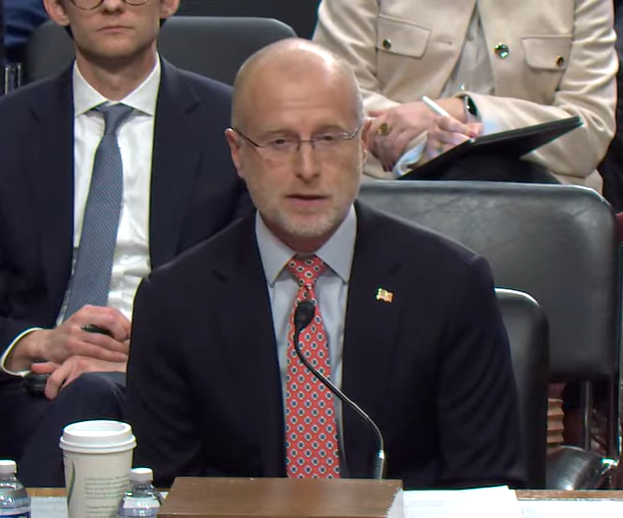
“We’re empowering broadcasters to meet their public interest obligations.” Those are the words of FCC Chairman Brendan Carr, as he offered a positive critique of his leadership and accomplishments at the Commission since taking the baton from Jessica Rosenworcel in late January at the first Senate Commerce Committee oversight hearing in five years.
lightly deviating in speech from his prepared testimony, Carr, appearing on Capitol Hill Wednesday for the hearing, noted how much of the Commission’s efforts under his tenure as Chairman “represents significant change” from the Biden years.
In his prepared remarks, Carr also applauded Committee Chairman Ted Cruz and Massachusetts Democrat Ed Markey for their leadership on the AM Radio for Every Vehicle Act. “This legislation will help keep AM radio — a linchpin of our emergency response system — in place and ensure that Americans can continue to access local news, information, and entertainment programming.”
Carr’s prepared testimony is seven pages in length, and much of it deals with non-broadcast initiatives.
However, there is a portion devoted to empowering local broadcasters. And, the controversial topic of public interest obligations is enmeshed in Carr’s philosophy of the Commission under his authority.
“The FCC is working to empower local broadcasters to serve the public interest and meet the needs of their communities,” he said. “As Congress, the Supreme Court, and the FCC have all made clear, broadcasters are different than every other distributor of media. Specifically, broadcasters are required by both the Communications Act and the terms of their FCC-issued licenses to operate in the public interest. This sets them apart from cable channels, podcasts, streaming services, social media, and countless other types of distributors that have no public interest obligation.”
Carr continued, “The FCC’s broadcast hoax rule, its news distortion policy, its political equal opportunity regulation, its prohibition on obscene, indecent, and profane content, its localism requirements — all of those and more apply uniquely to broadcasters. Congress has instructed the FCC to enforce public interest requirements on broadcasters. The FCC should do exactly that. Television broadcasters have this public interest obligation because the government has given them the unique privilege of using a scarce national resource—the public airwaves—and in doing so has necessarily excluded others that might want to broadcast their own programming over that same spectrum. That is why they are required to serve, not just their own narrow interest, but the public interest, including the needs of their local communities.”
In his prepared remarks, Carr also applauded Committee Chairman Ted Cruz and Massachusetts Democrat Ed Markey for their leadership on the AM Radio for Every Vehicle Act. “This legislation will help keep AM radio — a linchpin of our emergency response system — in place and ensure that Americans can continue to access local news, information, and entertainment programming.”
Rare to see a clear explanation of the reason for public interest obligations of broadcast.
Comments are closed.