
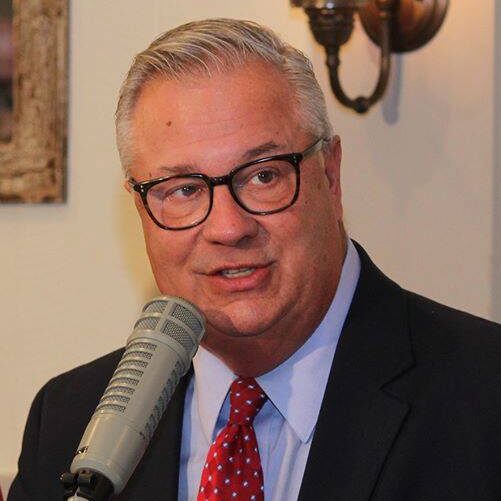
Inner Banks Media President Henry Hinton finally got a word in edgewise a week after he testified before the US Senate Judiciary Subcommittee on Intellectual Property, getting to make his full case for protecting local radio from extra performance royalties.
Hinton represented the National Association of Broadcasters at the December 9 hearing about the American Music Fairness Act, which would require terrestrial radio broadcasters to pay new and additional performance royalties to artists and record labels for airplay. He was largely steamrolled in the hearing, convened and attended by AMFA supporters.
Now, Hinton is speaking out freely on the latest NAB Podcast.
The bipartisan Local Radio Freedom Act, which opposes new performance royalties, has 216 co-sponsors in the House and 26 in the Senate, while the American Music Fairness Act has relatively little support. Still, Hinton said, the hearing did not reflect that balance. He entered the hearing as the only broadcaster at the witness table, tasked with explaining what’s at stake for thousands of local stations across the country.
“It was pretty much myself against the entire room, which was unfortunate,” Hinton said, describing an atmosphere that he felt misrepresented radio’s long-standing relationship with artists and its current financial reality. “The performers come to radio asking for help, and radio builds their careers,” he told Siciliano. “As I said in the hearing on Tuesday, it’s lasted for 100 years, and it’s worked.”
That dynamic, Hinton argued, is being unfairly recast by AMFA supporters, which this time around included star witness Gene Simmons. The KISS co-founder offered more spectacle than substance, with rambling testimony that at one point claimed radio is treating artists “worse than slaves.”
“It’s shameful to me that there are many that are trying to get this bill passed for the music industry, that they’re portraying that performers are angry at radio. I don’t believe that for a second. The performers come to radio asking for help, and radio builds their careers,” said Hinton.
Throughout the hearing, Hinton pushed back on arguments that painted the radio industry as outdated or one-sided. “Radio revenue is down 20% since 2019, while the recording industry is hitting record highs,” he said. “The PRO landscape is broken… and to add a performance royalty on top of a system that’s already broken is wrong.” He warned that new fees would hit small and mid-sized operators hardest, jeopardizing their ability to replace critical equipment or fund community programming.
“In markets this size, they can’t afford any new fees like this,” he said.
While much of the Senate hearing focused on licensing, economics, and legislative frameworks, Hinton used both the hearing and the podcast to emphasize radio’s civic mission, especially during emergencies. “We do have a public service obligation,” he said. “It’s part of the deal that radio has had with the people in America for all these years.”
Hinton described how that obligation becomes mission-critical during hurricane season. “We’re used to it. I mean, it’s a bullseye on us almost every time,” he said of the region’s recurring exposure to storms. He recalled Hurricane Matthew in 2016 as a defining moment for his stations. “I’m in the studio taking phone calls from people who are calling me from Harkers Island… They were calling us and crying and saying they didn’t have water. ‘Can someone tell us where we can get water? I don’t have water to make formula for my baby.’”
In that storm, and many since, Hinton said his stations served as the only functioning communications link. “We were their only lifeline during that hurricane,” he said. “Spotify, Pandora, and Apple Music aren’t going to do that.”
Reflecting on what he hopes Washington and the public take away from his testimony, Hinton made the case for broadcast radio’s continued relevance. “Local radio is unique. We’re free. We’re over the air. We’re part of our communities,” he said. “Congress should be working with us instead of working against us.”