


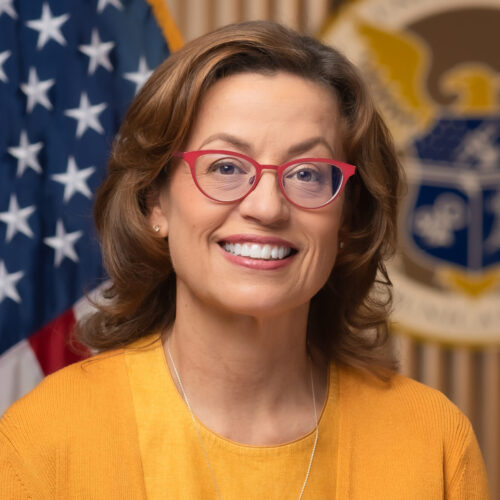
Less than a week after fellow Commissioner Olivia Trusty expressed her belief that broadcast ownership deregulation would boost competition, the FCC’s Anna Gomez used her State of the Net Conference address on Monday to argue for just the opposite.
The speech, which acknowledged the 30th anniversary of the Telecommunications Act of 1996, emphasized its core aims: to preserve competition, localism, and viewpoint diversity as technology evolved.
“Thirty years ago, Congress set out to modernize communications law while protecting values that it understood could not be left to market forces alone. Competition. Localism. Accountability,” Gomez said. “Those values remain relevant, and unfinished. The FCC’s responsibility is not to manage consolidation, but to steward a media ecosystem that serves consumers and communities in the real world. If we keep that focus, we can meet this moment without sacrificing the voices that make our democracy work.”
Gomez argued that the FCC should pursue targeted, market-specific policies that help local media respond to streaming competition and declining advertising revenue without sacrificing local ownership. She warned that treating consolidation as the default solution risks repeating the mistakes that “hollowed out” local newspapers.
“Newspapers were not eliminated because people stopped caring about news. They were hollowed out through consolidation, cost-cutting, and the loss of advertising revenue to digital platforms, as ownership decisions were increasingly made far from the communities they affected,” Gomez stated.
The Democratic Commissioner also raised concerns about regulatory pressure on broadcasters, noting that corporate broadcast owners with significant business before the FCC face pressure to avoid regulatory conflict when the agency threatens consequences based on programming content.
“Rather than asking how competition can best serve consumers and local communities, real economic pressure is treated as justification for consolidation without consideration of whether the outcome will continue to serve the public interest. Guardrails are framed as obstacles. And consumer interests risk becoming an afterthought.”
“This is not competition policy serving consumers. It is using competition rhetoric to justify consolidation,” she said. “From a consumer perspective, the consequences are clear. Greater concentration reduces meaningful choice. It weakens competition for local advertising and local audiences. And it compounds the very pressures that have already hollowed out local journalism elsewhere.”
The Commission is currently in the middle of the 2022 Quadrennial Review of radio and television ownership limits, with no clues on any forthcoming potential decision per FCC Chairman Brendan Carr.