




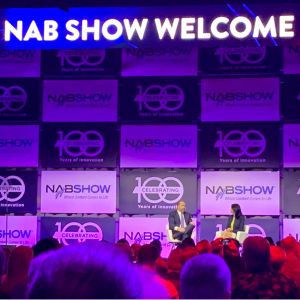
When he took the Main Stage for his fireside chat at NAB Show, Curtis LeGeyt, President and CEO of the National Association of Broadcasters, spoke about the importance of radio in the car dashboard, the significance of local broadcasting, the attacks on journalists, and the media, competing with big tech, and the future of broadcasting.
LeGeyt acknowledged the importance of radio in the car dashboard, stating that it still plays a relevant role in people’s lives. According to Nielsen, 82 million Americans tuned into AM radio at some point over the last month, making it a highly relevant medium. In addition, AM radio plays a crucial role in the Emergency Alerting System, providing irreplaceable backbone support during disasters. It reminds people to tune into their local media, with AM stations serving as the primary medium for emergency alerts that go through the broadcast system.
LeGeyt also spoke about the importance of local broadcasting, which brings together people of different worldviews, persuasions, and interests. Local broadcasting serves as a platform that enables communities to come together and solve common problems, including gun violence, incidents of police brutality, and other issues that impact a community. Broadcasting has people on the ground who know these communities and how to talk about the issues that matter to them, making it relevant to specific groups with different socioeconomic backgrounds and races.
Furthermore, LeGeyt addressed the attacks on journalists and the media, acknowledging that the current climate is challenging for journalists who face violence, harassment, and social media trolling. He emphasized the importance of NAB serving as a loud megaphone for the incredible work that journalists across the country are doing, reminding both communities and policymakers that they are the ones who roll up their sleeves in these communities, shining a light on abuses, and providing essential information to communities.
LeGeyt also talked about the challenges of competing with big tech companies that have changed everything, including the local advertising market and the audience migration to online platforms. He mentioned that big tech companies have significant market power that enables them to determine the terms of access that do not allow for fair compensation for broadcasting content. LeGeyt suggested that regulations needed to be modernized to reflect the reality of today’s marketplace, where broadcasters are competing with everyone.
LeGeyt concluded his remarks by emphasizing the importance of innovation and hyperlocal connections with communities, which he believes is the competitive advantage of broadcasting. It is this relevance in both television and radio that will enable the industry to thrive as a strong competitor in the media landscape, but also as an indispensable function for local communities across the country.

