

Those are the words of WTOP Director of News & Programming Julia Ziegler from a note she sent to the WTOP news team as the events from Wednesday began to wind down and she had a chance to catch her breath. We interviewed Ziegler Thursday to find out exactly how WTOP sprung into action as events quickly changed Wednesday afternoon.
Radio Ink: t what point did you get the sense that this was going to be more than a Trump rally?
Julia Ziegler: We knew before Wednesday that it was more than a rally. Our National Security Correspondent JJ Green had been talking with his sources for weeks. We had also been following the groups attending the rally on social media and could see what they were telling their supporters. Of course, no one could have predicted that rioters would break into the Capitol but we knew there would be a lot of people and that fact alone could cause issues. So we were ready for it to be a big event and we staffed up accordingly. But, if we’re talking about the day itself, I’d say things changed for me and our newsroom when we started to see the first images of the massive number of trespassers on the steps of the Capitol building. That’s when the day really took a turn and we knew this would be bigger than we thought.
Radio Ink: With so many ways to reach listeners these days, how did WTOP report on the events?
Julia Ziegler: Our reporters in the field were communicating back to our desk using WhatsApp (you can send text and audio messages through this service) and we’ve found it to be really helpful when cell service takes a dive. The audio sent through WhatsApp is recorded audio not live.
Our reporters also have Skype on their phones and that worked for live interviews for parts of the day yesterday
Our reporters also have downloaded the FieldTap app on their phones which is an app that allows them to connect back to the studio via a Comrex unit
Slack – we use this to send recorded audio files from the field, video and photos back to the newsroom
For part of the day, our Capitol Hill correspondent was still able to use his office setup that connects directly to our studio so that helped tremendously
Cell – when all else fails.
Text – sometimes texting an audio file will work when sending something via another service wont.
Radio Ink: What changes did you have to make on the fly and did you have to call in other reporters?
Julia Ziegler: What wasn’t changed on the fly? Lol. All of your plans go out the window in breaking news and you are flying by the seat of your pants. Reporters assignments change at a moment’s notice. Your dealing with technology issues (large gatherings mean terrible cell service) and all of that means reporters you have scheduled for live hits sometimes drop out or don’t come through.
From a staffing perspective, we had prepared well by scheduling additional staffers but we still ended up calling in additional people beyond that. We called in some extra producers and reporters to help sift through information as it was coming into the newsroom. We brought on an additional social media staffer. Some staffers came in early and many (if not all) stayed late.
Radio Ink: What was the reaction you were seeing on social media?
Julia Ziegler: During the day while everything was happening, we were mostly using social media as a tool to help us decipher what was going on. What are people posting? What can we verify? What are official sources posting? And, of course, WTOP News was using social media to disseminate information to our consumers – latest info, photos, videos…
Radio Ink: Were any of your reporters ever in danger?
Julia Ziegler: There is always an element of danger at a large event like this where you know tensions might be high or easily provoked. Add to that the element of danger we have all been dealing with since March 2020 – coronavirus. Anytime our reporters are in a setting where there is a lot of people and social distancing is non-existent, coronavirus adds another layer of concern. Our reporters who covered this on scene yesterday (Alejandro Alvarez, Ken Duffy and Mitchell Miller) are pros. They have been in this type of situation before and know how to read the signs. Safety always comes first and they know they can back away or back out of a situation at any time.
Radio Ink: Tell us how you believe your team performed during such a fluid news story?
Julia Ziegler: I always tell people that what makes WTOP different is the people. That was on full display yesterday as every single person rallied together. I’ll share with you the note I sent to the newsroom Thursday:
“I don’t know where to start. What we all watched unfold yesterday invoked so many different emotions in me for many different reasons. Like many of you, I oftentimes don’t have time to process what is happening when we’re in the heat of the moment trying to get the news out. As I got home late last night and started to decompress, I thought about how what happened at the Capitol yesterday will eventually become what history books refer to as a defining moment in America.
It then occurred to me, that our team has shared more life-defining moments in the last 12 months than some people share in decades…
Non-journalists will never understand what the past year has been like for those of us in the news business – while “normal” people can turn the news off if they need a break, we cannot.
Our coverage across platforms over the past 24 hours has been nothing less than spectacular. And that is because of all of you. Like always, you stepped up. You answered the call. You stayed late to help your teammates. You came to work on your day off. You came BACK to work after leaving for the day. You checked in on your colleagues to make sure they were safe. You thought of others before thinking of yourselves.
I said it last year when I took this job…and I’ll say it again. WTOP is different because of the people who work here.
I’m grateful to be in the news trenches with all of you.”
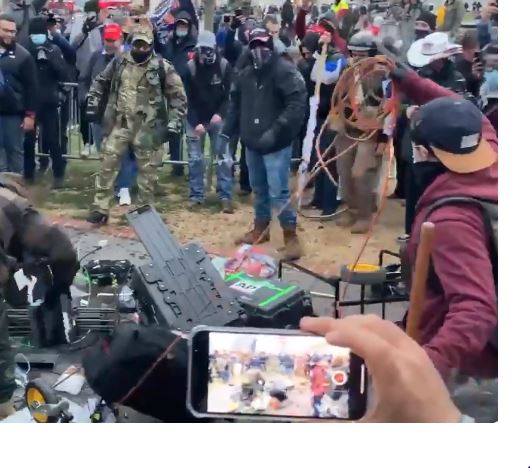
Picture courtesy Ken Duffy (@kenduffynews on Twitter). Ken is a WTOP reporter and was reporting live from the scene.