

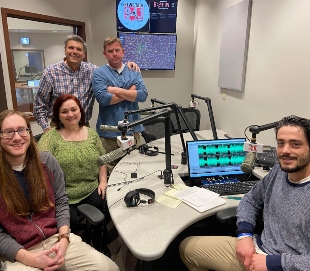
Larry Stone is the owner of Stonecom Communications. The company owns four stations and two translators in the city of Cookeville, about an hour from Nashville in Tennessee. Stone and his team were extremely close to the exact location where the recent tornado touched down killing over 20 people. We spoke to Stone about how his team sprung into action to help their community.
Radio Ink: Tell us about what happened when the tornado came through?
Larry: We got our emergency system [warning] in my home a little after midnight when the storm was coming into the Nashville area. I got up immediately and turned on the TV. When you saw the picture of the actual funnel cloud, a lot of the storms we have in this part of the world are rain-wrapped, you don’t get those graphic pictures, so when you saw that in Nashville it makes you think. I started watching the coverage and tracking through the national weather service — some of the information we get, and watching. You’re thinking, Is this going to follow the track? And it started following the track of I-40, moving from Nashville. That’s when we decided to get to the radio station and be ready to let people know.
Radio Ink: How close are you personally and how close is the radio station to all of this?
Larry: The radio station is a mile from where I live. The radio station, as the crow flies, is about 10 miles from where the tornado ended. It’s about a 10-minute drive where this tornado started. Again, it’s weird how it followed the highway, Highway 70, from Baxter, Tennessee — minutes from downtown Cookeville is where the storm lifted back into the clouds.
Radio Ink: What did you do to get your team into action? Obviously everyone was asleep. What were the steps to get rolling on something this big?
Larry: It’s hard to talk about because it feels like you’re bragging and that’s not what I am trying to do. Our staff is amazing. They understand our commitment to community, that’s what we want to be known for. We believe that the service element is very important and we try to do that 24/7, 365. We believe the storm touched down at 1:50. We were on the air around 1:30 on all four of our stations, tracking it the best we can. We have been clear to our listeners, “When we tell you to get to your safe place, you need to get to your safe place.” We don’t red alert or alarm like some other media do. We call it as close as we can from the information we are getting from the weather service and spotters. We stayed on the air from 1:30 a.m. till 12:30 in the afternoon. Non-stop; no commercials. I was able, as we were talking, to use my cell phone to call people. I didn’t have to talk because they saw it was a call from me. They got in their car and came to the radio station. Our news director went immediately to the scene. Our morning host on our Country stations, Jason Bailey, went immediately to the scene. Driving into these affected areas, telling us what they were seeing. It went along with the information we were getting from spotters and emergency management. We have an emergency management team in this county that you could put up against Nashville, Knoxville, or any other city bigger than us. They do an amazing job. We started seeing reports that homes were destroyed. We started relaying information. We opened the phone lines. The studio where we were set up as our control center is our news-talk station. We built a new building about a year ago and had lines put in — we have never used them on the air, never told the audience what they were, and we started giving the numbers. People started calling and telling us what they were seeing. People who lived in the area, or coming into or out of work at the end of a shift. We started putting the pieces together. Probably about 5:30 or 6 we had the sheriff calling in, our county mayor, city mayor calling in. It came together and we’ve worked hard to serve the communities over the days since.
Radio Ink: What is the warning system for a tornado? You said you were on the air at 1:30 but the storm came in at 1:50? Did you know anything earlier about the possibilities of a tornado?
Larry: I think sometimes the TV stations can go overboard with warnings and you worry about these situations because people get complacent. There was some concern that started Monday night with a mention of possible severe weather, but it wasn’t an advertised thing. When I saw the storm in Nashville I knew it was the real deal, not radar indicated. There was a real funnel cloud. I came to Tennessee to start the Titans network when the team moved from Houston. I could see where, in Nashville, the storm was and to see that heightened my awareness that this was serious. The weather service has a chat service that we subscribe to and we could see some of the reports. That’s what really got it going. Then the phones start going off to alert people of the tornado warning. This particular storm went right down the interstate. It was near the football stadium in Nashville, then into Mt. Juliet near the airport, Lebanon, and Wilson county. Then it lifted and touched down again near Baxter at the top of the mountain there. They issued all the warnings. The sirens are meant for outside alert and there are few people outside at 1:30 in the morning. It’s devastating that 18 people are dead; that it happened in the middle of the night. You have time with a hurricane but with this you don’t know, it’s unpredictable. Our meteorologist said on the air, as much as we know about tornados there’s more we still don’t know. We don’t know exactly why a storm produces a tornado and that’s the hard part. We think with all the technology that we’ve mastered all these things. This makes you realize we don’t have a lot of say in these things.
Radio Ink: How many stations do you have? What cities are they in?
Larry: We are in Cookville, which is about an hour from Nashville. Cookeville is the largest micropolitan in this area. Tennessee Tech University is here. In the state, it’s the place between Knoxville and Nashville that you stop to eat. People who are going to a Titans game, this is where they congregate. It’s the hub of about 11 or 12 county areas called the Upper Cumberland of Tennessee. We have four stations and two translators that serve this area.
Radio Ink: How long have you been there?
Larry: I bought the stations in 2011.
Radio Ink: What is your plan to help the community heal and get people what they need to rebuild?
Larry: We are still focused on the information part of this. We’ve been on the air till 12:30 the day after, on at the top of every hour. We did two hours of coverage at 5 p.m. that evening. We did a prayer vigil put together by our promotions team that happened on the courthouse steps, which were full that evening. We started coverage again the past two days, and again tomorrow, with about 10 to 12 minutes at the top and bottom of every hour. We have had the mayors on and sheriff on to provide information. This is the volunteer state and the Tennessee Volunteers just had to put the call out — they had too much stuff. They are overrun with donations. They asked people to stop. They had 2,500 volunteers show up yesterday to go out and cut limbs, remove debris. It brings a tear to your eye.
Radio Ink: Talk about your team and how they did it?
Larry: They are amazing. Everybody stepped in. One of our sellers walks in the door at 5:15 Tuesday morning and sits behind me answering my phone. She didn’t have to do that but she did. Every one of the teams asked, “What can I do? How can I help?” Jason Bailey co-anchored with me for five hours on Tuesday morning, allowing our news director to work sources. Our morning sidekick got in the car and went to shelters talking to people, and he is the furthest thing away from a news-trained journalist, and he did some of the most touching stories we heard in the first few hours. People not on the air have brought food, made sure phones are charged, paper in the printer etc. I mentioned the prayer vigil. Our promotions director got five ministers coming to speak and people willing to provide music. We had a lawn full of people in three hours trying to help the community to heal. I am so proud of our staff ,who keep asking, “What can we do?” You know we live in a 15-minute news cycle, so everybody wants to get back to normal. They have been saying, “What can we do long term?” We have three, four, five, six things we want to do in the next six weeks to help. We had a repair shop call yesterday and say they are going to be sharpening blades. We had an insurance agent call and say they had charging stations. It hasn’t mattered if they are a client or not, we have put it on the air and repeated it over and over again. That’s what you do in this situation. We believe the job of a radio station in a community like this is to serve, and not about making money or winning awards. It’s about doing and being consistent. I think everybody sees what the vision is. I never wanted anything like this to happen, but it’s so rewarding to see how everyone reacted and what they’ve done. I couldn’t be more proud and I love them more than I can say.
Reach out to Larry to congratulate him and his team at [email protected]