


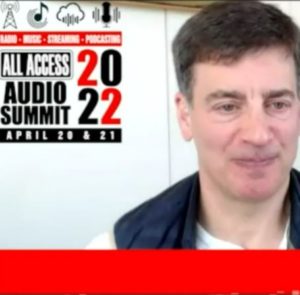
Audacy CEO David Field was the leadoff interview at the 2022 All Access Audio Summit Wednesday. Field’s 45-minute interview with All Access CEO Joel Denver covered everything from the length of stopsets to podcasting to his merger with CBS Radio.
Field started off by saying that he could not be more excited about where Audacy is now and where the company is headed. He said the company is off to a great start this year with 200 million people consuming Audacy content through its various platforms which include radio stations, the Audacy app and podcasts.
When Denver asked Field if Audacy was making money at podcasting, Field answered yes. “We have boldly, thoughtfully, carved out an attractive position. We see a path to grow margin.” The backbone of the Audacy podcast division is Cadence13, Pineapple Street Media and Podcorn, Audacy’s three major acquisitions in that space.
On CBS Radio
Field said his only regret was that he was unable to do that deal sooner. “Our colleagues at CBS Radio were not ready until late 2017.” Field said that enabled his radio competitors to get a head start on putting together a fully scaleable offering.
On Radio’s Downward Trajectory
Field doesn’t agree that radio is on a downward slide. “Through the most robust explosion of change, the digitization of lives, the massive disruption, radio’s disruption pales when compared to print, TV and other media. The vast majority of audio listening continues to be radio.”
Field agrees there’s fragmentation but not a downward trajectory of radio. “We need to continue to enhance the listening experience. We need to continue to improve the quality of the listening experience both over-the-air and streaming.”
On The Length of Stopsets
While Field believes the industry needs to continue to get better in this area he also says that he does not see a substantial impact on listening levels from commercial loads today. “The amount of commercials work for the consumer.” He also added the quality of the commercials must be top notch. When Denver asked Field about 10-minute long pods, Field said at some point it becomes egregious. “And that’s intolerable. We want to be thoughtful.”
Things Radio Needs to Change
Field says radio needs to continue to improve and invest in the digital experience for the listener. “Make it a great experience.” And, he says radio needs to do a better job of promoting itself. “Radio needs to think of itself as a legacy brand and a challenger brand.”
“Deregulation put the focus on efficiencies, such as eliminating duplicate staff support jobs across the same company-owned stations.”
Efficiencies are a product of good business, not deregulation. There are efficiencies in every business, not just radio. Good management seeks to eliminate duplication, and it happened long before deregulation. Radio stations used networks in the 30s and 40s. They used automated formats in the 60s and 70s. Satellite syndication in the 80s and 90s. Then voice-tracking began in 1993. All before deregulation.
These corporate types… Field, Pittman, Beasley and others are of a different mindset than the leaders of radio decades ago. Because the entire industry went through a seismological change with deregulation. The ownership focus on 1 or 2 stations in a market, investing in and cultivating strong local personalities, spending significant promotional money, and limiting commercial breaks, all went away.
Deregulation put the focus on efficiencies, such as eliminating duplicate staff support jobs across the same company-owned stations. The focus and priority became debt-servicing and executive comoensation.
And with many corporate-owned stations, the product was devalued greatly – such as Dickey at Cumulus gutting the stations of the top local personalities and Clear Channel/iHeart doing much of the same. Because these corporate “leaders” (not really) view local talent and other personnel as “expense items”. And these corporations added intolerably long commercial breaks, due to the need for more and more revenue for debt service and executive comp.
With these horrible practices, millions of listeners – especially younger ones- became disenchanted with the devalued over the air radio product, and turned to streaming apps. Witness for example the fall of CHR- KIIS Radio, once dominant in LA, is now a shell of itself. The under 35’s simply will not tolerate 15 or 18 commercials in a row. …Nice job, iHeart!
The Perfect Storm. There is no turning back. And sadly, the corporate “leaders” of radio are old, old, old. 60 and over in most cases, including Pittman, Field, and Beasley. Similar to when newspapers declined, when you had publishers who had been there forever. Young people are the major innovators and creative risk-takers, old people not so much.
And don’t tell me that “innovation” is taking your diluted FM product, slapping it on a streaming app and proclaiming that you’re “digital” now! KIIS FM on streaming, with 15 commercials in a row, doesn’t have a chance in Hell against Spotify. Especially with the under 35’s.
And yet, Field says he is upbeat. …I want what he’s smoking!!
Field says radio needs to continue to improve and invest in the digital experience for the listener.
We have $10 webcams & free versions of video streaming platforms. We want to be better than 12 year olds on Tik Tok, Field went on to say.
Mr. Field said 10 minute long breaks were too long. Maybe he should check in with his Minneapolis radio group. 2 weeks ago at 10am on a Saturday on WCCO radio, they played a pair of half hour long infomericals. When you’re doing that in prime time on a Saturday, you have lost your way. But that’s radio today in a lot of markets and I never thought I’d live long enough to see it, but here we are.
The eternal optimist. Whether a late-night pick-up game in the gym during management conferences, or participating in an aggressive paintball challenge, David never heard the buzzer to end the game. He played on (fairly) till the other side wore down. By most industry metrics of operations, Entercom, ETC, Audacy individually and collectively have always been (in my personal experience) the gold standard of corporate radio, now corporate ‘everything’. But I can only speak to the radio slice of things.
Comments are closed.