



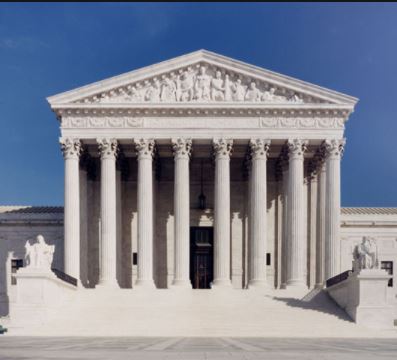
The Supreme Court of the United States overruled 90 years of precedent in a 6-3 ruling today that transforms the constitutional footing of every independent regulatory agency, including the FCC, by handing the President authority to remove Commissioners without cause.
The decision puts outspoken Democratic FCC Commissioner Anna Gomez’s tenure directly in question.
The ruling in Trump v. Slaughter overturns Humphrey’s Executor v. United States (1935), which had shielded FTC and FCC commissioners, among others, from at-will presidential removal. The Court reversed and remanded a District of Columbia federal court judgment that had reinstated FTC Commissioner Rebecca Slaughter after President Trump fired her in March 2025 without identifying a statutory cause.
Chief Justice John Roberts, writing for the majority, held that the FTC’s for-cause removal protection violated the separation of powers because the agency exercises core executive power that must remain under the President’s control.
The FCC, unlike the FTC, has no explicit for-cause removal provision in the Communications Act, a distinction that leaves Gomez with less statutory protection than Slaughter possessed. The ruling now removes the constitutional argument that would have underpinned any legal challenge Gomez might mount against removal. She has previously stated publicly that she would sue if fired mid-term.
The majority was direct about scope: officers who exercise executive power are “subject to removal” by the President, and Congress cannot restrict that power. The FCC’s licensing authority, enforcement powers, and rulemaking functions place it squarely within that category.
The practical constraint on a Gomez removal is not legal but operational. The FCC currently has three Commissioners: Chairman Brendan Carr, Commissioner Olivia Trusty, and Gomez. Firing Gomez would leave the agency at two members, below the three-member quorum required to conduct official business. Trusty’s confirmation advanced out of the Senate Commerce Committee but has stalled awaiting a full floor vote, with several Senate Democrats conditioning support on a simultaneous Democratic nomination.
Gomez, who told Wired last week that she checks her email “every day” to see if she’s been fired, has been the Commission’s most vocal critic of the Carr FCC’s approach to broadcaster licensing, press freedom, and content oversight. She argued before the Senate that the FCC is an independent agency and “should be,” directly contradicting Carr’s December 2025 Senate testimony that the FCC is “not formally an independent agency” because commissioners can be removed by the President. Today’s ruling settles that dispute in Carr’s favor.
Justice Sonia Sotomayor, joined by Justices Elena Kagan and Ketanji Brown Jackson, dissented at length, arguing the majority disregarded 140 years of political practice and “reshapes our Government” by placing dozens of independent commissions under direct presidential control, including the Federal Energy Regulatory Commission, the Nuclear Regulatory Commission, and the Consumer Product Safety Commission. Justice Neil Gorsuch concurred but issued a separate warning that Congress had delegated vast legislative and judicial powers to independent agencies on the assumption those agencies would remain insulated from presidential control, and that stripping removal protections without addressing those delegations concentrates authority the Constitution assigned to three distinct branches in a single executive.
The Federal Reserve was explicitly carved out of the ruling, with the Court noting the central bank’s unique historical lineage may place it in a separate constitutional category.
Gomez’s term expires July 1. Under the Communications Act, she remains in office in holdover status until a confirmed successor is seated, a process that could stretch months given the Senate’s stalled confirmation calendar.
Whether the administration moves to remove Gomez without a successor and risks triggering an FCC quorum crisis in the middle of contested license proceedings involving ABC’s Disney-owned affiliates and pending ownership deregulation proceedings is now entirely a political calculation, not a legal one.