


Reaching more voters, not the same voters again, is the puzzle facing political advertisers this fall. Audacy’s answer, laid out in a new interview, starts in the car, where economic worry and radio listening overlap every day during the commute.
Audacy VP of Government and Political Partnerships Haley Teare-Lombardo and SVP of Research and Insights Ray Borelli discussed the research with Campaigns & Elections ahead of Election Day.
Radio Ink previously reported on Audacy’s June YouGov survey of 1,000 registered voters. In the interview, the executives say 59% of commuters name the economy and cost of living as the most important issue shaping their vote, a share that rises to 73% among commuting homeowners with children.
Borelli said, “So among people who are commuting two or more days a week, there were five points more likely or higher to say that the economy and the cost of living is the number one issue on their minds heading to the polls. And then among kind of your typical commuter, the suburban homeowner with kids, it was a whopping 19 points higher. So that was really interesting in terms of this intersection of economically frustrated voters and highly motivated voters spending a lot of time commuting.”
AM/FM captures 82% of ad-supported audio listening during weekday commuting hours, according to Audacy.
Teare-Lombardo clarified, “You’re not getting in the video space. So that, combined with reaching that commuter and reaching the people that aren’t watching TV, is a really added element to any campaign. And you really should consider adding audio to your media mix. We’re not saying either/or, but adding just elevates it even more with trying to reach that unduplicated, hard-to-reach voter.”
In Nielsen case studies from the 2022 midterms cited by Audacy, radio added 676,000 incremental voters, a 10% increase, to Senator John Fetterman’s TV and CTV reach in Pennsylvania, and 659,000, an 18% increase, to Senator Raphael Warnock’s in Georgia. In Nevada, Borelli said, the Republican candidate for governor put 4% of his spending into radio and gained about 100,000 incremental voters. Joe Lombardo won that race by 15,386 votes.
Teare-Lombardo commented, “We’re saying shift some dollars anywhere from five to 20%. And you will see a significant difference in your reach. And you won’t see your TV buys or your connected TV buys diminished in any way by making that shift.”
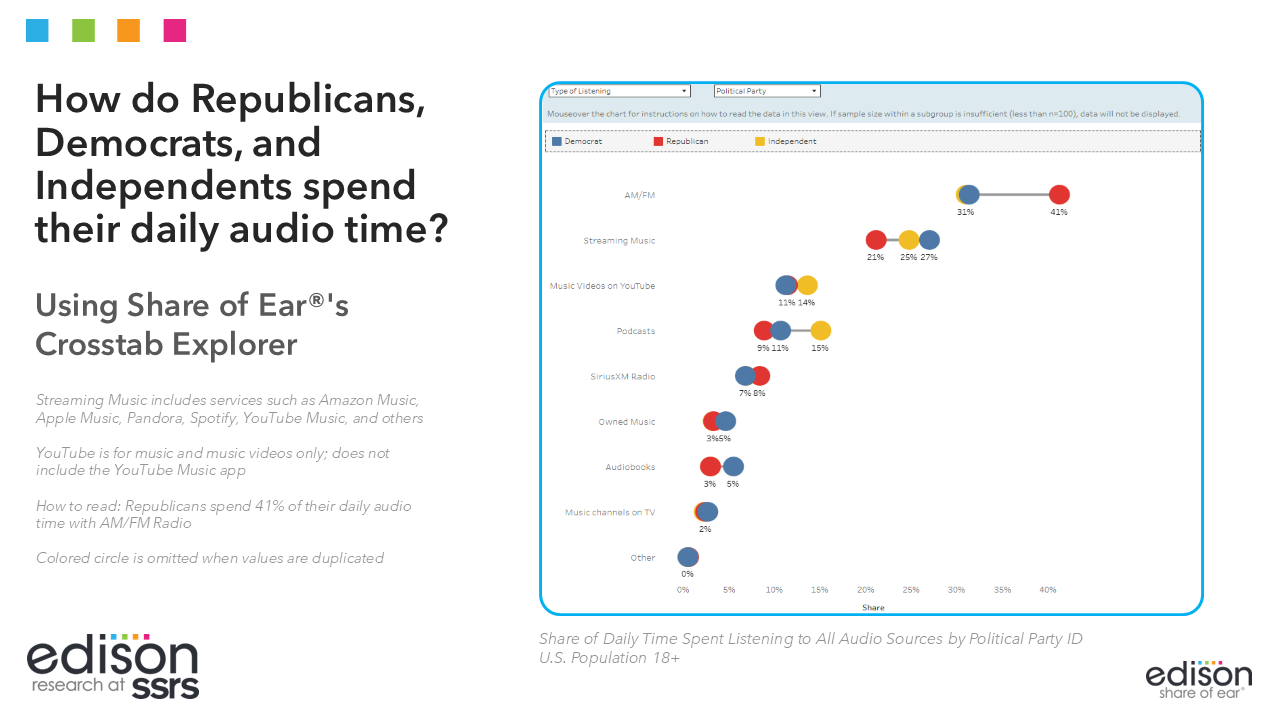
Edison Research Share of Ear data adds a partisan lens. Republicans spend 41% of their daily audio time with AM/FM radio, compared with 31% for Democrats, with Independents at about the same level as Democrats, according to the Share of Ear Crosstab Explorer for US adults 18+. Streaming music takes 27% of Democrats’ daily audio time, 25% of Independents’, and 21% of Republicans’, while podcasts draw 15% of Independents’ time, 11% of Democrats’, and 9% of Republicans’.
In July, Radio Ink reported that AM/FM captured 63% of the ad-supported audio time registered voters spend in a typical day, drawing 69% of Republicans’ ad-supported time, 61% of Democrats’, and 59% of Independents’.
iHeartMedia’s Insights blog cites a Nielsen Media Impact analysis across nine markets in which reallocating incremental media weight from TV to radio expanded voter reach while improving efficiency. Audio generated up to 62% registered voter reach and up to 69% swing voter reach, with 25% to 31% greater cost efficiency than adding more TV weight alone, according to the post.
The post also argues for pairing audio with CTV, saying audio builds familiarity while CTV reinforces recognition, and that voters move between broadcast radio, streaming audio, podcasts, and CTV throughout the day.