




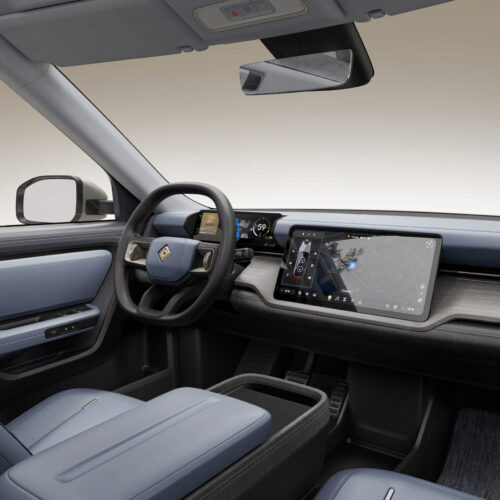
As broadcasters fight to keep AM radio in the dashboard, another automaker is cutting FM. Rivian’s new R2, which entered the market earlier this month, has removed all terrestrial radio access, replacing the tuner and antenna with a data connection.
In its place, the sport utility vehicle carries a pre-loaded iHeartRadio app and a subscription tier called Connect+ that unlocks the rest of the in-vehicle audio stack. The R2 starts at $44,990. Connect+ runs $14.99 per month or $149.99 annually and is required for native in-vehicle data streaming. iHeartRadio does not require Connect+, nor does Bluetooth, but both depend on cellular coverage, which can fail in rural terrain and emergency conditions where broadcast radio keeps working.
Edison Research shows AM/FM commands roughly 55% of in-car listening time nationally. Rivian, which has never offered AM radio in any of its models, claims its own figures tell a different story for its buyers. The company told RivianTrackr that FM usage on the R1 landed in the single digits as a share of listening time.
Rivian is not the first EV maker to go tuner-free. Tesla has removed terrestrial radio from its latest Model 3 Standard and Model Y Standard trims, but the trend may soon no longer be limited to electric vehicles unless action is taken. At the 2026 New York International Auto Show, Dodge and Chrysler CEO Matt McAlear floated a “back-to-basics” philosophy for entry-level gas and electric vehicles alike that would strip out built-in AM/FM access entirely.
NAB VP of Communications Carrie Healey told Radio Ink, “The decision to remove traditional radio receivers from certain new EV models demonstrates exactly why Congress must act to preserve drivers’ access to free, local radio and the critical emergency information it provides.”
“When emergencies strike, Americans need reliable access to trusted local news, weather alerts, and public safety information. While wireless services fail in times of natural disaster, the broadcast infrastructure provides a time-tested and resilient way to spread vital emergency information. That’s why AM radio makes up the backbone of the Emergency Alert System. By passing the AM Radio for Every Vehicle Act, Congress will help ensure this essential public service remains available to drivers nationwide.”
Meanwhile, lawmakers appear closer than ever to passing the AM Radio for Every Vehicle Act, which was embedded into the Motor Vehicle Modernization Act of 2026 after a 48-1 House Energy and Commerce Committee vote. That bill could itself be absorbed into the BUILD America 250 Act, the surface transportation reauthorization package moving toward the House floor before highway and transit authorities expire September 30.
The AM Act also continues advancing independently as H.R. 979/S. 315, with nearly 380 House and Senate cosponsors, which US House Majority Whip Tom Emmer says would pass the floor overwhelmingly if the majority leader scheduled a standalone vote.
Emmer sat down with NAB’s Airtime podcast to discuss the bill’s status and his own read on why it has built rare bipartisan momentum. He also pointed to emergency preparedness as the core policy argument, saying, “You sometimes have to have that local station that they can broadcast on the AM dial where you can pick up. This is what’s open. This is where you can get water, there’s food available, there’s medical care.”
“AM radio, I think people, when faced with the proposition that it’s going to go away, you’re seeing a natural reaction from people in Congress, reacting not only themselves, but to their constituents.”
The NAB has released PSAs in English and Spanish asking radio listeners to contact their members of Congress by texting AM to 39179, urging them to support legislation that ensures AM radio remains in cars. Get them for your station here.
A car radio gives better gas mileage!
How often have you pulled into your destination but paused to let the radio show finish!
Just more reason NOT to buy a new vehicle, especially an EV. In 1962, UHF reception was mandated on television receivers. ALL of the audio services should be mandated on radio receivers. Congress is mostly lawyers who don’t know the difference between shoe polish (Shinola) and feces.
I’m just going to say it. This is precisely what radio operators should be optimizing for: creating unique experiences for infinite opportunities given the data pipe coming into the vehicle. They could create something great that ALL manufacturers (and consumers) want and that makes traditional RF a thing of the past. Those experiences could transcend the vehicle and move into the home. As usual nobody in radio is smart enough to “get it” and they continue to push for AM radio through a sorry excuse of an organization (Congress) that has a 16% approval rating with the US public. You keep telling people you’re “digital first.” I see no evidence of it anywhere. Those who operate stations in Detroit should be sitting down with the Big 3 and creating the future together. Instead they’re trying to force reception of a band that has no listenership and no hope. The industry skirts reality by lumping radio in as an “ad supported” form of audio. The industry says, “We reach 86% of ad supported audio listeners.” Gee, that’s great guys. Even Edison will tell you that 37% of Americans 13+ now completely avoid ad supported audio. That number is 46% among 13-34 year olds. We’re quickly coming to a point when teens and twenty somethings will ask the following question: “Dad, what’s a radio?” Hurry up, radio. Your shot clock is running out of time.
Comments are closed.