


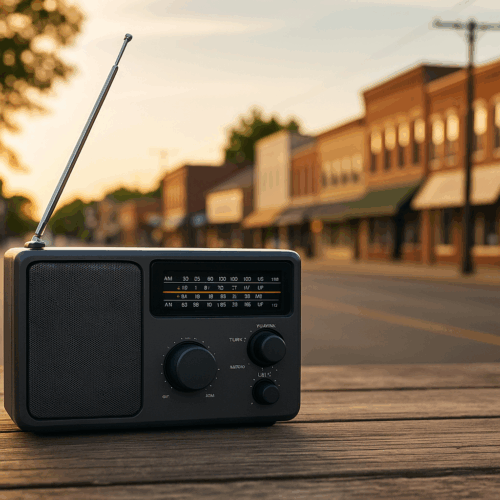
Advertisers can’t buy listeners who don’t hear ads, and AM/FM radio reaches nearly double the percentage captured by the combined ad-supported audience of Spotify, Pandora, and podcasts, according to new data from Edison Research at SSRS.
Cumulus Media/Westwood One Audio Active Group analysis of Edison’s Share of Ear shows AM/FM reached 56% of adults daily from Q3 2025 through Q2 2026. That advantage extends across every ad-supported platform Edison tracks.
Among adults 18 and older, radio reaches nine times the daily audience of ad-supported Pandora (6%) and eight times that of ad-supported Spotify (7%), with 22% of adults listening to podcasts and 4% to ad-supported SiriusXM.
Time spent tells the same story, and for advertisers, more time means more opportunities to deliver a message. Adults 18 and older average 1 hour and 17 minutes daily with AM/FM radio, compared to 7 minutes with ad-supported Spotify and 6 minutes with ad-supported Pandora. Overlap between the two audiences is limited, which matters for reach planning rather than duplication.
Among adults who listen to either AM/FM radio or digital audio, defined by Edison as ad-supported Pandora, ad-supported Spotify, and podcasts, 55% listen only to AM/FM radio, 23% listen to both, and 21% listen only to digital audio.
That separation is exactly why AM/FM performs best in Edison’s incremental reach modeling, the metric that most directly answers what a station buy actually adds to a media plan. When Edison modeled incremental daily reach across ad-supported Spotify, ad-supported Pandora, podcasts, OTA radio, and ad-supported SiriusXM, AM/FM radio added more incremental reach than any other single platform regardless of where it landed in the plan, contributing 40% incremental reach among persons 18 and older when layered onto streaming platforms already in the mix.
Podcasts ranked second, adding 20.1 percentage points in the same scenario.
The pattern held across demographics advertisers care about most. Among persons 25 to 54, AM/FM radio contributed 36 percentage points of incremental daily reach, more than any other platform tested, while among persons 35 to 64 that figure rose to 43.8 percentage points.
Reach has also proven resilient among smart speaker owners. That group spends 7% more time with audio daily than the total US population and shows the same 57% radio daily reach as the general population age 13 and older, with daily AM/FM listening time of 1 hour and 12 minutes among smart speaker owners compared to 1 hour and 16 minutes nationally.