


Senate Democrats used the hearing meant to introduce the next potential FCC commissioner to put her current boss on notice. With the gavels changing parties next year, one senator said Chairman Brendan Carr’s tenure could end in “three or four months.”
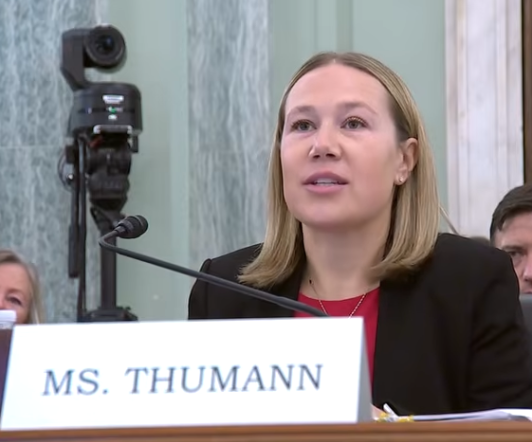
Danielle Thumann Severs, current senior counsel to Carr, faced the Senate Commerce Committee on Tuesday for a hearing on her nomination to the FCC made by President Trump. If confirmed, Thumann Severs would join Carr and Commissioner Olivia Trusty as a third Republican, filling a seat left vacant when Republican Nathan Simington and Democrat Geoffrey Starks departed in 2025.
In her opening statement, Thumann Severs described herself as “a product of rural America,” and said she would focus on modernizing communications networks. While there was no outright reference in her remarks to broadcasters, that topic was quickly broached by the committee’s Democrats.
Sen. Ed Markey (D-MA) opened by objecting to the hearing itself. Markey stated, “After the American people last week overwhelmingly rejected the MAGA agenda, there is no justification for this committee to advance partisan nominees during the lame duck period.”
Markey added, “We should be investigating the FCC, not confirming a Brendan Carr advisor to the commission.”
He also tied the nomination to Commissioner Anna Gomez, the commission’s lone Democrat, whose term expired June 30. Markey remarked, “We should not be confirming a Republican nominee without also re-nominating and confirming Anna Gomez, the Democrat, and filling the other vacant Democratic seat.” Earlier this month, 21 House Democrats made the same request of Senate leaders.
The exchange most relevant to radio broadcasters came when Markey asked whether the FCC has the authority to punish a broadcaster because the president disagrees with its news coverage. Severs answered, “Broadcasters are subject to public interest obligations as part of the public trustee model in exchange for the licenses that they hold. As part of those public interest obligations, they are subject to many different rules and requirements, and the FCC is charged with enforcing and investigating the public interest standard against broadcasters.”
Markey then pointed to Carr’s remarks during the Jimmy Kimmel controversy, when Carr said, “we can do this the easy way or the hard way.” Severs responded, “Those were his words. They were not my words, and I have not advised him or worked with the chairman on these particular issues.”
Markey replied, “Again, you are continuing to evade.” He added, “Anyone seeking a seat on the Federal Communications Commission must be willing to stand up to such threats and to defend the First Amendment. And you are not willing to do so here in your confirmation hearing.”
When asked by Sen. Tammy Duckworth (D-IL) whether a broadcaster’s editorial decisions should factor into whether it keeps its license, Severs stated, “It can consider many different factors, including content, as part of that public interest evaluation. But again, they are also entitled to First Amendment protections.” She added, “I don’t think that a decision should be made purely based on someone’s discontent with the content that’s being aired.”
On the FCC’s independence, Severs commented, “Whether or not the FCC is independent is a constitutional question. Following Trump v. Slaughter, commissioners at the FCC are now removable without cause, no longer making it an independent agency.” She said she learned several weeks after the fact that the commission had removed language describing itself as independent from its website.
Lastly, Sen. Ben Ray Luján (D-NM) used his closing remarks to address Carr directly. Luján said, “I voted for Brendan Carr when President Biden nominated him. He’s a different commissioner today than he was then.”
He then warned, “I don’t think Chairman Carr is going to be around more than another three or four months. Because when we have the gavels in here, he will be here once a month. And Mr. Carr, if you’re listening now, know you’re going to be in this body once a month, if not more, and in the House of Representatives as well. Answering questions and you don’t have the protection of the gavel any longer. Subpoena authorities that you have to respond to. So we can get to the bottom of the nonsense and the cover-ups that have been taking place.”
Republicans on the panel focused on other topics. Committee Chairman Ted Cruz (R-TX) asked whether she would commit to basing licensing decisions on the law and the record and to not using the FCC’s authority to pressure or punish a broadcaster for protected speech. Her answer: “Yes.” She also said yes when he asked whether she supports the Jawbone Act, his bipartisan bill with Sen. Ron Wyden (D-OR), which targets government pressure on speech.
Senators have until the close of business on November 12 to submit written questions, and the nominees have until November 16 to respond. The committee would then vote on whether to advance the nomination to the full Senate.