


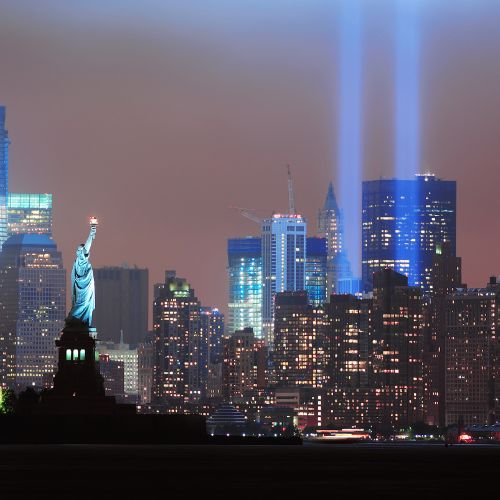
Twenty-five years ago this morning, there was no social media. No text threads lighting up with “are you okay?” When the towers fell, landline and early cell networks in New York City buckled almost immediately, jammed by hundreds of thousands of people trying to reach someone, anyone, at once.
What people had was radio.
In cars, in offices, on the street, on transistor sets pulled out of desk drawers, radio was the line that stayed open. It didn’t just report the news that morning. It held a frightened nation together, one voice at a time.
Harvey Nagler, Radio Ink‘s 2026 Lifetime Leadership Award honoree, was Vice President of CBS News Radio on September 11, 2001, overseeing coverage that reached hundreds of affiliate stations nationwide. Nagler had run a newsroom through crisis before, including when a car bomb exploded at the World Trade Center in 1993. Nothing, he says, prepared him for that day.
“Any reporter, any manager worth their salt who lived through 9/11 will tell you it was the most difficult time of their career, because you had no idea how things were going to end, and the horrific nature of what occurred when you’re putting people in the field really tests your leadership. I think the awards we won for our coverage say a lot about its quality, but more importantly, about the people who were out there reporting on those events. I lived in the city for five days and didn’t leave during 9/11, given the catastrophic nature of what had occurred.”
“I had been at WCBS back in ’93, when the car bomb went off at the World Trade Center. So when word came in around 8:47 that morning, we immediately went on the air for continuous coverage and stayed on the air the rest of the day. You instinctively know, unfortunately, that this is going to be a horrific story, but you have no idea how it’s going to turn out. No one had any idea what was going on when that first plane went into the World Trade Center.”
“Tom Kaminski, our helicopter reporter for WCBS, was flying over the area, and his description of what was happening was fed out live to our hundreds of affiliates. We were in a position to describe what was unfolding in vivid detail from Tom’s helicopter, before the FAA ordered him out of the area.”
“Whether you were on the front line as a reporter, a writer, a manager, or a producer, you’re never going to forget what happened on 9/11, and in the days that followed.”
Nagler’s network coverage was reaching the country. On the ground in Manhattan, individual stations were doing the same thing for their own listeners, live, unscripted, with no idea what was coming next. At 1010 WINS, that meant turning to whoever was closest to the story.
On that day, Scott Herman was VP/General Manager of WINS. Earlier this month, he shared his story with the Broadcasters Foundation of America.
“When the first plane hit the South Tower around 8:45 in the morning, we actually had our first on-scene report from one of our top salespeople, Joan Fleischer. She lived in Lower Manhattan and was reporting on what she saw from the rooftop of her building.”
“Every radio station in NYC was in wall-to-wall coverage, comforting New Yorkers as only radio can. Listeners’ favorite people to listen to were actually holding their hands through the radio. Every format, every station: WCBS, WABC, WOR, Z-100, WPLJ, Howard Stern. Music stations only played somber music that didn’t talk about death or destruction. Talk stations talked. News stations reported. But 1010 WINS is New York’s station of record, the place people turn to when they hear of disaster. Our calling was never more important or tested.”
“Our main job that day was to report the facts as they unfolded, not only in New York but in Washington at the Pentagon and in Pennsylvania, where another plane went down. We did it brilliantly and flawlessly, and so did our radio brethren. My memory at the end of that day, as I drove home to New Jersey around 9:00 p.m. and headed toward the Holland Tunnel, was that the New York skyline would never be the same without those two towers.”
“One lasting memory, etched in my brain, is when WINS reporter John Montone returned to the radio station around 3:00 in the afternoon, covered in soot, joined by a man he had met at Ground Zero. The man said he was too afraid to be alone, and John was kind enough to stay with him and take him back to the station.”
“Twenty-five years later, I remain extremely proud of the work of the men and women of 1010 WINS, and of the role that all of New York radio played in comforting New Yorkers and helping our city heal in the days and weeks that followed.”
That same real, unscripted radio audio, the sound of stations like Herman’s talking a frightened city through the unimaginable, is exactly what Art Vuolo preserved.
Away from the newsrooms and the control rooms, the shock of that day traveled with people wherever they went next, including Radio Ink President and Publisher Deborah Parenti.
“The horror of September 11 was still fresh when I left Philadelphia two days later, bound for DuBois, Pennsylvania, to consult a radio station mid-sale. Leaving the urban sprawl, I drove through the rolling farmlands of the Susquehanna Valley and climbed into the dense forests and high ridges of the Pennsylvania Wilds. The silence was striking, the skies completely empty of planes. Then, seemingly out of nowhere on a mountaintop, a crane appeared, flying an American flag proudly against the blank but sunny sky. As if on cue, Lee Greenwood’s “God Bless the U.S.A.” filled the car from the radio. I pulled over and wept.”
“DuBois is only 100 miles from Shanksville, and you could feel that heavy proximity the moment I arrived. Surrounded by strangers, I felt an instant, protective bond built on raw grief and shared professional instincts. We weren’t there to ‘call on accounts.’ Our real mission was to comfort people up and down Main Street.”
“Yet community life was quietly pressing forward. A local department store was holding a long-planned grand opening that morning, so we went to observe. To my surprise, the parking lot was full, and shoppers were eagerly making their way inside. It taught me an unforgettable lesson: no matter the heartbreak, the clock never stops. Even through genuine grief, people will always look for a ray of light.”
A Final Word
The World Trade Center’s North Tower carried a 360-foot broadcast mast that fed a master FM antenna serving five New York radio stations and eight television antennas. When the tower fell, so did most of the city’s TV and FM transmission capability, along with six broadcast engineers who were still working at their posts on the 110th floor: Donald DiFranco, Gerrard “Rod” Coppola, Steve Jacobson, Bob Pattison, Isaias Rivera, and William Steckman.
The Communications Act charges every broadcaster with serving “the public interest, convenience, and necessity.” On September 11, 2001, these six broadcast engineers gave their lives in the ultimate fulfillment of that mandate.
Radio Ink honors their sacrifices and memories, as well as all of those who were tragically killed on that day twenty-five years ago.



Radio was the lifeline back then—nothing else could cut through the chaos. No tweets, no texts, just a voice you could trust. Hard to believe it’s been 25 years.
Comments are closed.