


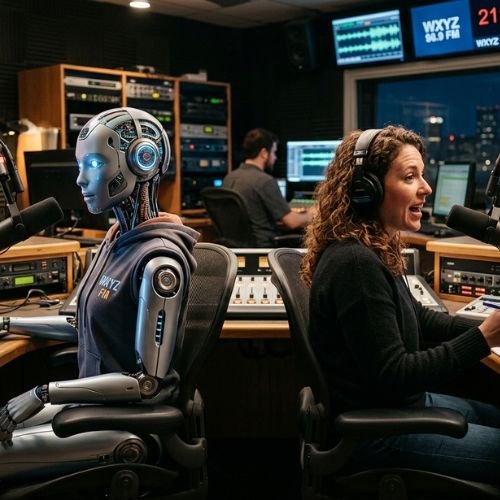
A host who nearly read an AI chatbot’s follow-up question on the air became the cautionary tale of a Mentoring and Inspiring Women in Radio webinar about using the tools for show prep, spots, and social clips without handing over the voice that keeps listeners tuned in.
“AI for Content Creators” featured Townsquare Media Regional Content Director and National Contesting Director and MIW board member Meg Dowdy in conversation with Audacy 102 JAMS (KRBQ) Brand Manager Andre Yancey, 93Q (KKBQ) Houston host and digital personality Lauren “Lo” Sessions, and Carolyn McArdle and Cort Johnson, co-hosts of iHeartMedia San Francisco’s The Morning Breeze.
Sessions opened with her approach to daily prep. “I use AI essentially as a brainstorming partner,” she stated. She asks for unexpected angles on trending stories and for listener-participation questions tied to Houston instead of generic topic lists. On keeping that output local and personal, Sessions remarked, “AI doesn’t know what it’s like to be me, right?” She added, “I think you can push back on AI. You don’t have to accept the first answer that it gives you.”
Yancey described building a prompt around the comedic style, delivery, and background of a personality he previously worked with, Ed Lover, so show prep could be written in that voice. On the risks of skipping the human step, Yancey commented, “The fact-checking isn’t there because we know AI hallucinates more than it doesn’t.” He said of leadership’s role, “If we can stay true and have integrity with our craft and then use AI as a second nature aspect, that’s how us in leadership can really get our talent to grow and stay within the realms of reality.”
McArdle and Johnson walked through using AI to draft endorsement and spec spots from client copy points. “It saves, I would say, a ton of time,” McArdle noted. She coaches the tool on details such as her connection to a client, then rewrites the copy. “There are times when ChatGPT or any other AI platform just leaves details out that are tremendously important, like a phone number or a website. So it’s sort of a starting point, I think, when it comes to writing copy, but it’s a great springboard,” she said.
Johnson explained his routine. “If I have AI help me with a script, I’ll typically pull it out. I’ll pull it into a Word document and then I’ll kind of rewrite it as me using the bones that AI gave me,” he stated. He said he should also be “feeding it back into AI so it knows what I went with” after he voices the finished spot. On graphics, Johnson expressed, “It was making my job easier and it looked great, but it looked too great.”
On repurposing, Sessions turns her 60 to 90 second on-air pop-culture feature into social video. “We don’t always need to create more content. But sometimes we just need to get more mileage out of the content that we’re already creating, you know,” she said. Yancey described running air checks through Opus and CapCut to find shorter clips, and a monthly newsletter that shows sales and corporate teams what 102 JAMS produced.
Dowdy shared a three-step approach she calls meta-prompting, in which users give the AI a role, context, and a clear goal, then ask it what it needs to know to write the prompt. “Don’t waste time struggling trying to come up with the perfect prompt,” she remarked.
The cautionary tale in question came up when an attendee asked what the biggest mistake was when the panelists first started using AI. McArdle answered first: “Ripping and reading.”
She had used a chatbot to produce an endorsement spot, then asked it to rewrite the copy with changes. “I didn’t see the commercial coming. It was one that I do all the time,” McArdle stated. “I hit write again, but change it up. Literally, that’s what I typed into ChatGPT on that. And in the middle of it somewhere, it said, would you like your endorsement to blank, blank, blank?”
The stray question was still sitting in the script while she was live on the air. “So as I’m reading it on the air and I tend to read ahead, I see this coming,” McArdle remarked. She dropped out of the copy partway through the spot and finished with a line pointing listeners to the client for more information. “Just make sure you proof everything,” she said.
Yancey said he avoided a mistake of that size. His early misstep was treating AI like a search engine, a habit he said he dropped.
MIW plans to announce a full schedule of free educational webinars for 2027. Radio professionals can sign up for the MIW email newsletter via the MIW website to hear first.